
Garage Door Repair: Repair or Replace? How Lakewood Homeowners Decide
Age is the worst reason to replace a garage door. A 15-year-old door with a broken spring usually makes more sense to repair. A 7-year-old door with a cracked panel sitting on a compromised frame might not. The decision comes down to whether the failure is mechanical or structural, and in our experience most homeowners get pushed toward replacement before anyone has explained that difference to them. Here’s the framework we use to think it through, so you can judge your own door honestly.
If you’d rather have a trained eye look at it before you decide, call (888) 287-5235. We answer 24/7, with fast dispatch from 7am to 7pm, Sunday through Friday.
Mechanical vs. structural: which kind of problem do you have?
Every garage door problem falls into one of two buckets, and which bucket yours lands in tells you most of what you need to know. Mechanical failures involve parts that wear out: springs, cables, rollers, hinges, and openers. Structural failures involve the door itself or the opening it hangs in: a warped frame, a buckled panel section, a header that’s moved, or a track that’s pulled away from the wall.
Mechanical problems are almost always worth repairing. They’re isolated to a part, the part is replaceable, and the rest of the door stays sound. Structural problems are a different conversation because the door’s geometry or the opening is compromised, and a new part on a bent frame won’t fix what’s actually wrong.
- Mechanical (usually repair): broken springs, frayed cables, worn rollers, a noisy or failing opener, hinges pulling loose, a door that’s off its track because a roller failed.
- Structural (often replace): rusted-through or buckled panel sections, a sagging header, a frame that’s warped or out of square, tracks that can’t be reset because the structure behind them has moved.
In Lakewood, we see plenty of both. The important part is that a technician actually diagnoses which one you’re facing, rather than glancing at the door and quoting a replacement.
How much does it cost to repair vs. replace a garage door in Lakewood?
A repair is almost always the smaller number. A broken spring, a set of worn rollers, or an opener that needs service is a parts-and-labor job, while a full replacement means a new door, new track in many cases, and the labor to install and dispose of the old one. The table below shows what each path typically involves, so you can compare like with like.
| Job | What’s involved | Typical estimate |
|---|---|---|
| Spring repair (one spring) | Replace a single torsion or extension spring | Small, single-part repair |
| Spring pair replacement | Matched pair, replaced together | Roughly double a single spring |
| Rollers, hinges, cables | Wear parts replaced, door re-balanced | Minor repair range |
| Opener repair | Diagnostics and repair on the existing unit | Varies by brand and fault |
| Single panel replacement | One damaged section swapped, if the frame is sound | Mid-range, below full replacement |
| Full door and opener replacement | New door, track, hardware, opener, disposal | The largest job on this list |
We quote each job on its own written estimate, and the price you agree to before any work starts is the price you pay. No surprise invoice once the door is down. Call (888) 287-5235 for a free estimate.
What’s the cost threshold for choosing replacement over repair?
Here’s the rule of thumb we share with homeowners: if the repair estimate climbs toward half the cost of a new door, replacement starts to make sense, especially on a door that’s already near the end of its service life. Below that threshold, repair is usually the better value. Above it, you’re putting money into a door that will keep asking for more.
The trick is getting a real replacement quote as your comparison point, without committing to anything. You can’t judge a repair against a number you guessed. Ask for a written replacement estimate alongside your repair quote and compare the two side by side. That’s the only fair way to see the gap.
- Get the repair quote in writing. What’s the specific fault, what part fixes it, what’s the price.
- Get a replacement quote too. Same visit if possible, so both numbers reflect the same door.
- Compare the repair to half the replacement. Well under half: repair. At or above half: weigh the age and condition of the rest of the door.
- Weigh the rest of the door’s health. A repair on an otherwise sound door is a good bet. A repair on a door with three other problems waiting is a stopgap.
This is exactly why we frame our approach as repair first. Diagnosing and fixing before recommending a new door builds the kind of trust that makes a homeowner want to call us again. On a comparison like this, the honest answer is usually the cheaper one, and we’d rather tell you that.
Is a single damaged panel a reason to replace the whole door?
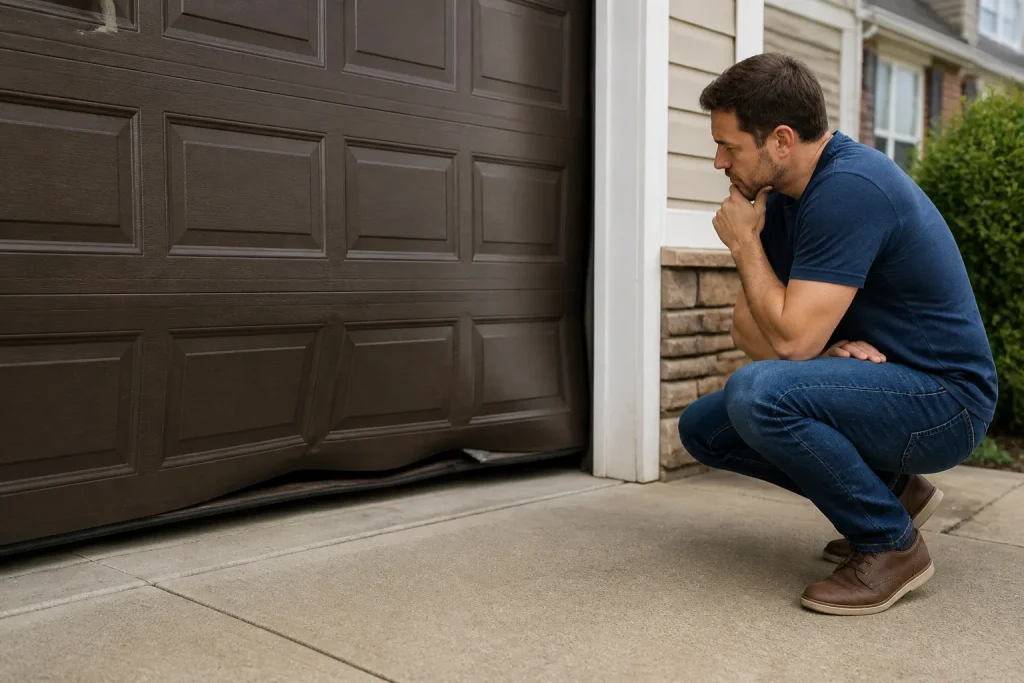
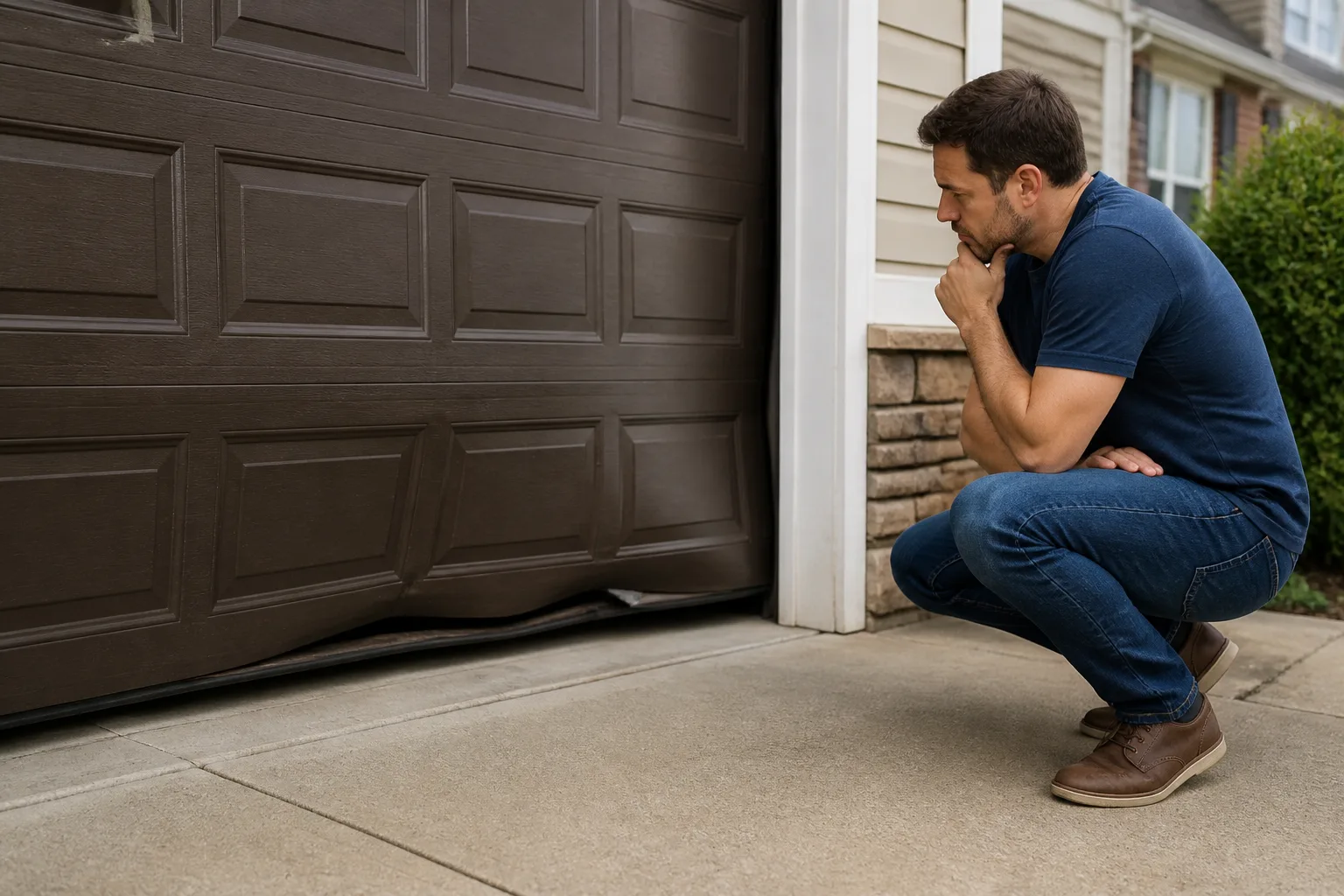
No. A single damaged section is one of the most common reasons homeowners get talked into a full replacement, and it’s rarely necessary. Panels are replaceable sections, and on many Clopay and Wayne Dalton doors a damaged panel can be swapped without touching the rest of the door. The question is whether the damage is cosmetic or structural.
- Cosmetic dents: a ding from a ball or a bike. The panel still holds its shape and the door still runs true. Usually leave it, or replace the one section if it bothers you.
- Structural panel failure: the panel has buckled, cracked, or rusted through, or it’s pulled away from the frame. This can affect how the door seals and how it travels on its track, and a section replacement only works if the frame behind it is still sound.
A decent technician will check the frame and track before quoting a panel, because a new section on a bent frame won’t sit right. If the frame is sound, one panel is a small job. If it isn’t, you’re in structural territory. That’s the honest split.
The hidden costs of replacement that quotes often leave out
A replacement quote that only lists the door and the labor can look cheaper than it turns out to be. Before you compare it to a repair, make sure the number covers the whole job.
- Disposal of the old door. Hauling away the old sections is real work, and it isn’t always included.
- New track if yours is non-standard. Not every door fits the existing track. If it doesn’t, new track adds to the job.
- Opener compatibility. If you’re upgrading to a smart opener or moving to a LiftMaster or Chamberlain unit, check it matches your new door’s weight and travel. An opener that worked with the old door may not suit the new one.
- Finish and hardware. Windows, decorative hardware, and a different finish all add up beyond the base door.
Ask for the replacement quote to include removal and disposal, track, and opener compatibility in writing. We service openers across the major brands, so we can tell you whether your existing unit will work with a new door before you commit. Call (888) 287-5235 and we’ll walk through the full scope.
How do Lakewood HOAs affect the repair-or-replace call?
In Lakewood, several neighborhoods fall under HOA rules that govern what a garage door can look like, and that changes the math. A replacement has to match the community’s approved styles, colors, and finishes, and getting sign-off can slow the job down or narrow your choices. Repair, by contrast, usually sidesteps the whole question.
If your door needs a replacement panel, matching the existing section to the rest of the door is straightforward and often clears HOA review without an argument about aesthetics. When a single section is the problem and the rest of the door is sound, repairing the panel is often the path of least resistance. You keep the look the community already approved and you avoid a board review over a new style.
Before you order a new door in an HOA neighborhood, check the community’s rules on door style and color. It’s a step that saves a lot of backtracking. If you’re weighing a panel against a full door, that HOA detail can be the tiebreaker, and it’s worth a conversation.
When to call a pro
Some jobs are worth a look from a trained technician, and some are genuinely dangerous to touch. Garage door springs are under high tension, and a spring or cable that lets go can cause serious injury. Don’t try to adjust, remove, or replace a spring or cable yourself. That’s the one part of this trade where we always recommend a pro. It’s also the repair we specialize in, and it’s one of the most frequently botched jobs in the trade when it’s done by someone guessing.
For the rest, if the door is off its track, making a new noise, or the opener has stopped responding, a diagnosis is quicker than you’d think. We work on your brand, from LiftMaster and Chamberlain to Genie, Clopay, Amarr, Wayne Dalton, Craftsman, and Raynor, so there’s no wondering whether your system is supported. Our technicians have up to 8 years of experience, and every one of them is a garage door specialist, not a generalist.
Related services in Lakewood: if your problem turns out to be mechanical, we can help with garage door repair, garage door opener repair, or garage door spring repair. If you’d like to know more about how we work, visit Eldridge Garage Door Repair.
The Bottom Line
Repair the mechanical failures. Weigh the structural ones carefully, and get a real replacement quote before you decide. Age matters far less than what’s actually broken, and a single damaged panel is rarely a reason to replace the whole door. Get both numbers in writing, compare the repair to roughly half the replacement cost, and factor in your Lakewood HOA rules if they apply. When replacement is the right call, ask for disposal, track, and opener compatibility in the quote so the numbers are honest.
If you’re in Lakewood and need help deciding, Eldridge Garage Door Repair offers free estimates. Call (888) 287-5235. We answer 24/7, with fast dispatch from 7am to 7pm, Sunday through Friday, and we’re closed Saturday. A call outside dispatch hours is booked into the next opening. The price is quoted and agreed before any work starts, and the estimate is free.
Frequently Asked Questions
Repair it if the problem is mechanical, like a broken spring, worn rollers, cables, or an opener fault. A 15-year-old door with a sound frame and panels can run for years more on a repair. Only lean toward replacement if the repair estimate approaches half the cost of a new door or the frame and panels are structurally compromised. Call (888) 287-5235 for a free estimate and a straight answer.
Repair is almost always cheaper than replacement, because it’s a parts-and-labor job on a fault rather than a new door, track, and disposal. The comparison that matters is the repair estimate against half the replacement cost. Get both quotes in writing so you’re comparing real numbers. Call (888) 287-5235 and estimates are free.
Yes, on many doors, as long as the frame and track behind the panel are sound. A cosmetically dented section usually isn’t worth touching, but a cracked or buckled panel can often be swapped on its own, which keeps the job small and helps with HOA style matching in Lakewood. Call (888) 287-5235 and we’ll confirm whether a panel replacement fits your door.
The local professionals we connect you with are licensed and insured as their state requires. We can work with your insurer if you’re filing a claim. Every technician is a garage door specialist, and our technicians have up to 8 years of experience. Call (888) 287-5235 for a free estimate, and the price is agreed before any work begins.
Written by the team at Eldridge Garage Door Repair.
Need Garage Door Help?
Call Eldridge Garage Door Repair - the local pro we connect you with is licensed and insured, here with fast help in Lakewood.
(888) 287-5235