
Top Signs You Need Garage Door Service – Don’t Ignore These
Your garage door doesn’t just suddenly fail. It argues with you for weeks first. The homeowners who end up paying for emergency repairs are almost always the ones who ignored a sound or a slowdown they wrote off as “just the weather.” If you want the short version: watch for uneven movement, new grinding or popping noises, a door that reverses on its own, and slow opener response. Any one of those means it’s time to call. If you’d rather not spend your afternoon guessing, call (888) 287-5235 and we’ll take a look.
What Is the Typical Failure Sequence for a Garage Door?
Most garage doors break down in a predictable order. Think of it as a chain of signals, and where you sit on that chain decides how much the fix costs. Early signs are easy to miss: the door moves a little unevenly, or there’s a new noise that wasn’t there last month. Mid-stage signs get harder to write off: the door reverses before it closes, the opener hesitates before it responds, or the door feels heavier than it should. Late stage is the obvious one – the door won’t open at all.
Here’s the pattern we’ve learned after years of diagnosing doors in Lakewood:
- Early signals: uneven movement, a new grinding noise, panels that look slightly off-level, a bottom seal starting to split.
- Mid-stage signals: the door reverses unexpectedly, the opener responds slowly, the motor sounds strained, you’re lifting the door by hand to get out.
- Late-stage signals: the door won’t budge, the cables are visibly slack or frayed, or you hear a loud snap from inside the garage.
The point of catching an early signal isn’t paranoia. It’s economics. A worn roller caught during a tune-up is a small fix. The same worn roller left alone can score a track, and now you’re replacing track instead of a roller. Every stage you wait costs more.
Why Your Door Working “If You Lift It Manually” Isn’t Fine
When a door only opens when you lift it yourself, that’s not the door “still working.” That’s the springs telling you they’ve lost tension and the opener doing work it was never designed to do. Springs carry most of the door’s weight; the opener just glides it up and down. When spring tension drops, the opener carries that load instead, and it starts straining, overheating, and wearing early. You’re trading a spring repair for an opener replacement – and that’s a bigger bill.
This symptom is one of the most common we see in Lakewood homes, and it’s also one of the most dangerous to ignore. Springs are under high tension and can cause serious injury if handled without the right tools and training. We never recommend a homeowner touch the springs or cables. This is one repair where calling a trained professional isn’t a matter of convenience – it’s a safety issue. That’s why we treat garage door spring repair as its own specialty, because it’s a different skill set from anything else on the door.
The 5-Minute Visual Inspection You Can Do Yourself
You don’t need tools to spot most real wear. Walk around your door with a flashlight and look at four things: cables, rollers, the bottom seal, and the door’s alignment. Five minutes is genuinely enough to catch what a technician would flag. What separates real wear from cosmetic aging? Look for these:
- Cables: any fraying, slack, or kinks in the steel cable is real wear, not cosmetics. Frayed cables can snap – don’t try to adjust them yourself.
- Rollers: flat spots, cracks, or wobbling as they roll means replacement. A worn roller is a cheap fix and an expensive one if it’s ignored.
- Bottom seal: splitting, crumbling, or gaps along the floor line. That’s an ordinary wear item, and it lets weather and pests in.
- Alignment: the door should sit level in the opening. A visible gap on one side usually points to spring or track problems.
One thing to be aware of: if the door looks slightly off-level and the opener strains to move it, don’t test the door repeatedly to diagnose it. Every cycle puts more strain on the system. Note what you see and let a technician take it from there.
How Lakewood’s Seasons Wear Out Your Door Faster
Lakewood’s weather does specific damage to specific parts, and knowing the pattern helps you plan instead of panic. Cold winters are the hardest season on springs. Metal contracts in the cold, and a spring that’s already lost tension is more likely to snap on the first cold morning of the year. That’s why we see more spring failures in the winter than any other time.
Humid summers are hard on the rest of the system. Rollers, hinges, and the bottom seal all wear faster with summer moisture, and cables are more prone to rust and stiffness. If your door is slower in July than it was in April, humidity is part of the reason. Doors fitted with a Clopay or Wayne Dalton panel system, or running a Genie or LiftMaster opener, all face the same seasonal wear – the brand doesn’t change the physics.
What this means in practice: a tune-up before winter is worth more than one in the spring. You’re checking springs before the cold finds the weak one.
The Cost Difference Between Catching It Early and Catching It Late
This is the part that makes the case for proactive service better than any warning we could write. A worn roller caught during a routine tune-up is a small line item. Left alone, that same roller can grind against the track, and now you’re looking at a roller replacement plus a track repair – two jobs instead of one. A spring caught in the early stage of losing tension is a straightforward spring replacement. A spring that snaps under load can damage the cables, the opener, and occasionally the panels above it.
We’re not going to quote “affordable prices” and call it a day. The honest version is this: every stage you wait adds to the repair. A tune-up that catches three small issues costs less than one late-stage repair. And on top of the price, you’re protecting the rest of the system – a strained opener from a bad spring is money you didn’t need to spend.
If you’d rather put eyes on it before the cold, we can help with garage door repair and give you a free written estimate. Repair first, always. We’d rather fix a roller than sell you a door you don’t need – and yes, we know that sounds like what everyone says. That’s exactly why we say it plainly.
When to Call a Pro
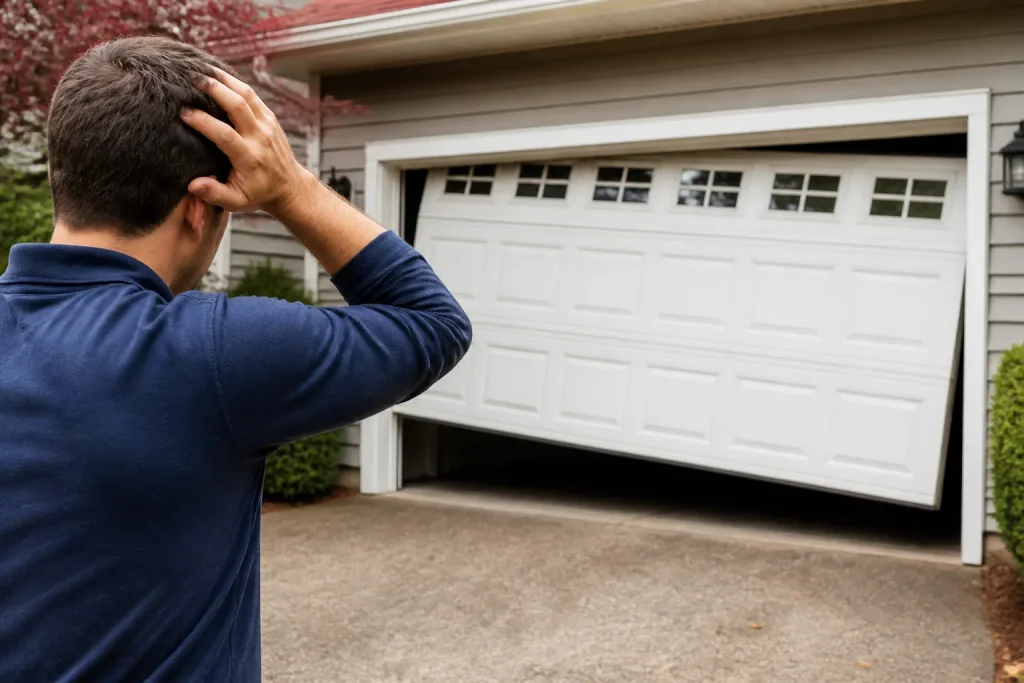
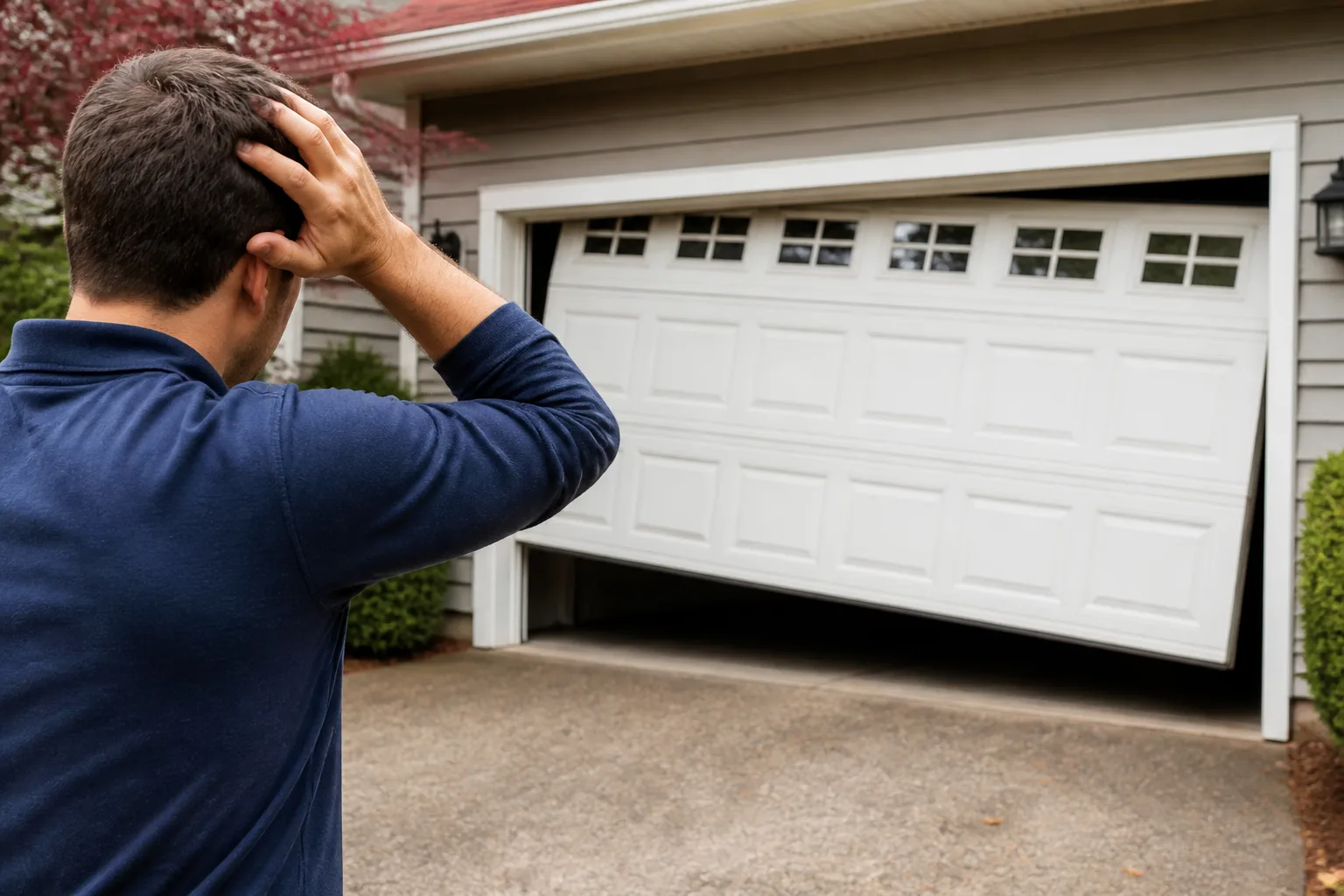
Most of this you can inspect yourself, but a few symptoms need a technician and nothing else. Call a pro if you hear a snap from the spring or cable area, if the door hangs at an angle, if a cable is visibly frayed, or if the door reverses or won’t close for reasons you can’t identify. Spring and cable work is high-tension and genuinely dangerous – that’s not a DIY job, and we’d rather say so.
Our technicians have up to 8 years of experience, and we work on all the major systems you’ll find in a Lakewood home – Genie and Chamberlain openers, Clopay and Amarr doors, and just about everything in between. If your problem is with the opener specifically, our garage door opener repair page covers the diagnostics we run. And if you ring us at night because a door won’t close, we answer 24/7.
Everything we do is set per job by a written estimate, agreed before any work starts. You’ll know the price before the tools come out.
The Bottom Line
The signs are the same for almost every door, and they show up in the same order. Catch the door when it’s uneven or grinding, or the opener’s slow, and you’re ahead. Catch it when the spring’s straining and the door needs a lift by hand and you’re still in affordable territory. Catch it when it won’t open at all, and you’re paying for what an early tune-up would have prevented. The chain is predictable, which is your advantage. If you’re in Lakewood and need help, Eldridge Garage Door Repair offers free estimates – call (888) 287-5235.
Frequently Asked Questions
The earliest signs are uneven movement, a new grinding or popping noise, slow opener response, and a bottom seal starting to split. Any one of them is worth a free look – they’re cheap to fix early and expensive to leave.
Yes, and manual lifting is itself the warning. A door that only opens when you lift it is almost certainly losing spring tension, and the opener is carrying strain it shouldn’t. Get it looked at before the spring fails entirely. Call (888) 287-5235 for a free estimate.
Winter. Cold shrinks the metal, and springs already near their limit are most likely to snap on the first cold mornings. A tune-up before the season starts is the best way to avoid that.
We don’t charge more for urgent work – the price is per job, set by the written estimate. The real cost of waiting is that a late-stage failure usually damages more than one part. Call (888) 287-5235 to book a repair; if you need us at night, we answer 24/7 and fast dispatch runs from 7am to 7pm, Sunday through Friday.
Yes. We’re certified across LiftMaster, Chamberlain, Genie, Clopay, Amarr, Wayne Dalton, Craftsman, and Raynor – which covers the vast majority of residential systems. So whether it’s a Genie opener or a Clopay door, we know your setup. Call (888) 287-5235 for a free estimate.
Four things: frayed or kinked cables, cracked or flat-spotted rollers, a split bottom seal, and any gap or unevenness at the door’s edges. Spot any of those and it’s time to call. If you’re not sure, we’ll check it for free.
Written by the team at Eldridge Garage Door Repair.
Call (888) 287-5235. We answer 24/7. Fast dispatch from 7am to 7pm, Sunday through Friday.
Need Garage Door Help?
Call Eldridge Garage Door Repair - the local pro we connect you with is licensed and insured, here with fast help in Lakewood.
(888) 287-5235